“Hope” is the thing with feathers – That perches in the soul – And sings the tune without the words – And never stops – at all –
And sweetest – in the Gale – is heard – And sore must be the storm – That could abash the little Bird That kept so many warm –
I’ve heard it in the chillest land – And on the strangest Sea – Yet – never – in Extremity, It asked a crumb – of me.
I’m glad to report that I’m still here to witness another circle around the sun. I recently mentioned that if I knew I was going to live this long, I would have taken better care of my body. A friend said, “I doubt it.” And I doubt it, too. Along with the creaky knees and weak shoulders, my life has been enriched by many great experiences, some of which I remember.
Whenever I sit down to write this missive, I try to bring in something new, but I always return to the theme of gratitude. I suppose that’s because it is the feeling that dominates my life. How can I not be grateful for all that I have, particularly all of you? Nonetheless, I’ll focus on something equally important, and more difficult these days: Hope.
It has been a challenging year for those of us who are dedicated to peace, social justice, and a sustainable environment. It doesn’t seem possible that lack of compassion has been interpreted as strength; that economic strength is measured by individual wealth rather than general prosperity; that we are diminished as a society because people from other countries came here to make a better life by contributing to our society; and that the natural world has only commercial value? It feels like the house I’ve spent my life working on is on fire.
At times, I’ve found myself lost in despair and mired in cynicism. What helps me rise up is hope. While the house was gutted in the blink of an eye, rebuilding will take longer. But I believe that the house will be stronger. The foundations of this country are deeper than political ideologies. I have hope. I have faith in my fellow Americans, whether born here or elsewhere. Faith that most of us will weather this storm. Faith that we will rebuild. It doesn’t erase my sadness, but it does lighten it, and helps me continue working for a better, more loving, peaceful, and compassionate world.
Some notes on driving across the country in an electric vehicle
A very slow EV charger
When I bought my fully electric vehicle, I knew there would be drawbacks—and a lot to learn. So, what better way to find out than to take it on a 7,500-mile road trip?
The first leg took me to Toronto to visit friends. My first charge stop was a Shell station that required an app. After downloading it, I discovered it wouldn’t work because I was “in the wrong country.” Frustrating but there was an Electrify Canada station ten miles away, and forty minutes later I was charged up and back on the road.
One of the challenges is the number of different charging networks. Each uses its own app, though some networks allow credit card payment at the charger. By the end of my trip, I’d charged about fifty times using ten different networks. A few times I couldn’t get a charger to work—some of that was my inexperience. For example, with most networks, you plug in first, then tap your phone on the charger; with Tesla, you set up the charge in their app before plugging in. Once I figured that out, Tesla proved to be the most convenient and reliable.
Not all chargers are functional, either. I encountered at least five that were broken, or whose credit card readers didn’t work—often in unsupervised public parking lots. I’ve heard of chargers being disabled because someone cut off the cable for its copper, though I didn’t run into that myself.
I had also expected charging to be cheaper than gas. At home, I pay about $0.18 per kWh—roughly $0.06 per mile. On this trip my charging costs averaged about $0.18 per mile. By comparison, a gas car getting 24 MPG at $3.50 per gallon costs about $0.15 per mile. Since most of my driving is local and uses home charging, it’s still considerably cheaper. Factoring in the reduced maintenance costs brings it down even more.
Another “feature” of public charging stations is the lack of posted prices, which vary widely. Unless you record the price and kWh at the time, it’s often hard to find later. Tesla stations record the date, location, cost, kWh, and price per kWh, but networks like Electrify America use a prepayment system, so your credit card statement doesn’t show what each charge costs. It’s great for their cash flow, but not for tracking expenses. After some digging, I found Electrify America was the priciest—$0.45 to $0.68 per kWh—while Tesla ranged from $0.48 to $0.56, and ChargePoint from $0.13 to $0.37 (with a few still free).
Convenience is another issue. We’re used to refueling a gas car in five minutes. Not so with EVs. Most stations are curbside, so with my charging port in the rear, I had to back in. The non-Tesla cables are heavy, and sometimes I had trouble making a connection with my adapter (I drive a Hyundai with a Tesla-style charging port). Tesla cables are lighter but short, often forcing me to park across the lines to reach (something Tesla acknowledges on their app). Honestly, managing a CCS plug is much more physically challenging than a gas pump hose.
Charging speeds vary widely. Most non-Tesla fast chargers use the CCS system, operating at 800 volts. Charging rates vary, but some are capable of providing 300 kW (that’s 300,000 Watts). My EV can accept about 200 kW, going from 20% to 80% in roughly 20 minutes. But not all CCS chargers deliver that much power, so I avoid anything under 90 kW—unless there’s food or something else worth doing nearby. Tesla chargers can approach 200 kW, but they run at 400 volts, so my Hyundai typically charges at about 100 kW there. (Note: kW is the power, or rate of charge, while kWh is the amount of energy, equivalent to one kW for one hour.)
I did see some interesting innovations. In remote areas of British Columbia, several BC Hydro stations had integrated battery storage, letting them deliver faster charging without overloading the grid. The units even displayed their current battery level.
Finding stations was another adventure. Unlike gas stations with huge signs advertising the prices, charging stations have minimal signage. The only wayfinding signs I saw were small blue “EV” signs for chargers in municipal lots. I spent a fair amount of time hunting for chargers shown in my mapping apps—some that no longer existed.
Speaking of apps, I used three: Plugshare, a generic app dedicated to finding charging stations; Hyundai’s navigation app, which automatically preconditions the battery for fast charging; and Google Maps, which remains the best for actual navigation—but oddly less knowledgeable about charger locations. I’d love to just use Hyundai’s app for the battery conditioning, but it’s clunky and inaccurate. I took more wrong turns with it than I care to admit.
Plugshare offers a lot of information about the stations, including the peak rate of charge, whether it’s down for repair, and user reviews. It also lets me plot routes and export them to Google Maps, though both limit the number of stops. Typically, I’d plan a day ahead and load the route into Google, but had to remember to start battery conditioning manually. I’m sure there’s a better way to save multipoint routes in Google Maps than emailing myself the link—but I haven’t figured it out yet.
Ideally, I’d like Hyundai to utilize Google Maps for navigation while still managing the battery conditioning. Barring that, I’d like to be able to use both simultaneously, but whenever I switch to the Hyundai map, Google stops and forgets the whole route. At some point, I will learn how to navigate the navigation systems. After all, during a good portion of my life, I navigated cross-country with paper maps, a skill now badly rusted.
Finally, I learned an important lesson: don’t wait too long to charge—especially in the middle of the country. I once arrived at a Tesla station in Nebraska only to discover it was Tesla-only (a certain percentage of their sites are). I had 19 miles left and 38 miles to the next station. I could have called AAA and had them tow me, but instead asked a convenience store if I could use an outdoor outlet. The clerk agreed, and my car optimistically estimated 64 hours, 32 minutes to reach 80%. I just needed enough for 40 miles.
After two hours, the guy came out and told me the owner had come by and told him to tell me to stop. I was at 25 miles. I drove 35 mph along a state highway, watching the range tick down. With one mile to go, the car complained loudly and flashed “Performance limited”—but I made it. Lesson learned. The next day, I detoured 40 miles into Colorado just to be safe. On the way home, I routed through Canada, where charging stations are more numerous (and cheaper).
Finally, I do want to say that I don’t regret switching to an EV. There’s nothing quite as smooth as an EV, and the extra weight is low and the car handles very well, and the cost of home charging is a fraction of the cost of gasoline. The inconvenience of public charging is a small price to pay for the ability to avoid gasoline altogether. Gasoline, besides being a fossil fuel, also can only reach an efficiency of less than 40% and generally are about 30% in internal combustion engines, with the rest of the energy going up in heat. Electric Vehicles, on the other hand, have efficiencies of 87% – 91%. There are energy losses associated with the transmission of electricity from where it is produced to where it is used, but these pale in comparison to the energy losses associated with distillation of gasoline from crude oil.
I’m writing this as a novice, so veteran EV drivers may smile at my naivety—and that’s fine. This trip was a learning experience, and if there’s one thing I love, it’s learning.
I’m starting this letter on Thanksgiving Day. It’s my favorite holiday because it’s less material than other holidays, and it’s about giving thanks, an action that gives me so much joy. I have a lot to give thanks for, and at the top of the list are you, my friends and family.
I’m spending Thanksgiving this year with my cousins, my mother’s sister Clara’s children. Aunt Clara died in October at 101, the last of that generation in my family and one of the few left alive in the world who lived through the Great Depression. In 1937, at 15, she traveled through Germany with my mother and their mother, and they saw Hitler parade through the town they were staying in. Despite, or maybe because of, those experiences, she was always grateful and generous.
This year is the first that I’ve really felt my age. The main lesson aging is teaching me is acceptance. I’m slowly learning to accept the reduction in my capabilities and ask for help. I’m also learning to moderate my ambition. As Christine Lavin sang in “Shining my Flashlight at the Moon,” “Adjust your dreams.” We are very attached to ambition in our culture and feel a need to reach higher each day. The challenge is to find satisfaction in other ways. Quite often, it’s helping or encouraging someone else, but sometimes it’s not doing something. More often these days, I find myself just taking a moment to experience the beauty of the world around me.
Of course, the year has been dominated by the new dog in my life. Having had four of the best dogs in the world, who have all lived 14 years and bookmark the sections of my life, I was a little anxious about how Bran would fare against these pillars of canine society. I’m happy to say that he is faring quite well. Like my previous dogs, he could be more obedient, but I never made that a priority. Instead, I prefer dogs who are responsible, socially adept, and bring joy to the world.
In that regard, Bran has not disappointed. He loves other dogs and people and plays enthusiastically, but chills out and doesn’t beg for attention when I have to shift my focus away from him. Unlike my other dogs, he is not a counter-surfer. It’s almost too good to be true, and now I’m lax about leaving food around, something I’ll regret when some of his more accomplished counter-surfing friends visit.
With that, I’ll wind up and wish you all the best for the holiday season. Be kind, be grateful, and make it a mission to leave everyone you come in contact with happier than they were. I hope this letter has left you happier than when you started reading it.
“I believe compassion to be one of the few things we can practice that will bring immediate and long-term happiness to our lives. I’m not talking about the short-term gratification of pleasures like sex, drugs or gambling (though I’m not knocking them), but something that will bring true and lasting happiness. The kind that sticks.”
My life has many chapters, but until now, they were contained in four volumes, one for each of my four dogs: Suzy, Odin, Rama, and Angus. All lived 14 years and I have spent a couple of dogless years between the passing of one and the entry of another into my life. Suzy arrived when I was 6, Odin when I was 22, Rama when I was 38, and Angus when I was 52; corresponding to different stages of life. Their lives were shaped by my level of maturity (and immaturity), and my life was shaped by them.
Bran at 7 weeks
When I chose this puppy, I did so because I met his parents. Both were friendly and inquisitive and didn’t hold back. When I picked him up yesterday, I pointed his mom out to my brother by saying, “The one whose tail is wagging faster and harder than all the others.” I would like to think that’s the way people portray me…but I know that I can also be the curmudgeon. Perhaps this guy will soften my edges and I, too, will be wagging faster and harder than those around me, bringing a modicum of joy to the world.
Naming a dog is not something to be taken lightly. I have been drawn to the dog as god or dog as hero motif. Odin was named after the leader of the Norse pantheon who sacrificed an eye to drink from Mimir’s Well to gain knowledge and wisdom. Several times, my Odin came back with cuts near his eye from fights with wild animals. There is power in names.
My original idea was to name him “Fionn mac Cumhail” (Fin mac Cool in English), a hero from the Irish tradition. Driving down to collect him, I listened again to the story of Fionn’s life and the complicated. sometimes tragic events of it, and decided he didn’t need to be saddled with that kind of complexity. Instead, I chose “Bran,” the name of one of his hunting dogs. Bran’s life wasn’t without challenges, but they were simple acts of courage and devotion. I hope that my Bran’s challenges are as simple, but less risky, like stealing bread off the counter when I’m in the same room, and figuring out how to blame the cat (that I don’t have).
And so today, at 68, my new teacher, has arrived, and the next volume begins. Already, my life is changing…and not just because I got up six times in the night to let him out to pee. Since Angus’ passing, there are so many times I’ve reflexively looked to see where he was or planned my day to park in the shade. These are my default behaviors, and I look forward to exercising them again to a purpose.
As Bran barks softly in his sleep, I wonder what he is dreaming. Whatever his dreams, I hope I can make some of them come true.
Top row: Bran’s mother, Pepper; father, Mason; great-grandmother, Shoney. Bottom row: 4 weeks, 7 weeks (when I picked him up 4/7/23) with my brother, Gord, and with me.
Thanks to Wayne and Lynn Schapp at Eastlake Labradors for their patience with my questions, their warm hospitality whenever I’ve dropped by, and for providing me with this beautiful puppy.
As I noted in the Overview, I started noticing landscapes from the beginning. Routes I’ve driven hundreds of times suddenly revealed themselves. The colors of the fields in May, the play of water on rock, and the mud in the Salmon River all stood out.
Passing through Montezuma Wildlife Refuge, I remembered witnessing a miracle. A dog jumped out of the back of a truck, rolled, and got up dazed in the median. The driver hadn’t seen what happened, so he didn’t stop, but I pulled over on the right shoulder. The dog was a little dazed but saw my car and was able to run safely across from the median. I opened the back door, and he jumped into the car. Speeding down the road, I found the truck about four miles down, pulled over, and a distraught young man and his father were looking around for the dog. They were amazed and relieved when I pulled over with the dog. He was bleeding from road rash and limping but seemed otherwise healthy, considering the circumstances. I regret that I didn’t get their number to find out how the dog made out. The young man was a police officer, and the dog, his K-9 in training.
The trip to Rochester was another familiar one, as I grew up in Geneseo, and my parents lived there until their passing. Buffalo wasn’t new, either, and I’d made the trip to Pittsburgh numerous times. Still, leaving the shores of Lake Erie and heading south into the Appalachian Mountains stirred something. Unlike some places where the mountains rise abruptly from the plain, here the plains turn to hills and finally to gentle, eastern mountains.
I stayed the night with a friend in Sewickley, a suburb of Pittsburgh with a character all its own. The houses were modest and clean, but the legacy of river-as-industrial-resource meant that the banks of the Ohio River that runs through it aren’t easy to access for recreation. There was a boat launch, but it was a concrete affair, and even the park a few blocks down didn’t have access. In fact, both sides of the river were bounded by roadways, leaving little space on the banks.
Sewickley to Ottawa, IL
Leaving Sewickley, the route backtracked from the day before, then cut west through Ohio—Youngstown, and Cleveland—and onto the very flat plains of northern Indiana and Illinois. After the rolling hills, the flat plain left more room for sky. The horizon was near and very low. I remember a rainy Thanksgiving Day in Wisconsin, riding south from Madison to Springfield, IL, to join a friend’s family. I was pretty hungover and periodically, I would look out, and the view stretched for miles. It finally dawned on me that these were the views from the Interstate overpasses, the highest point for miles.
Iowa
The trip from Ottawa to Davenport, on the Mississippi River that forms the border between Iowa and Illinois, was about 100 miles. Once into Iowa, the land began to gently undulate. Instead of being dead flat, it rolled a little and had creeks and sloughs running through it. Something about this change was mesmerizing, but I can’t seem to find words to describe it.
There were also smoothly bordered oblong grass patches. They were clearly deliberate in the planted fields, and it was a mystery how the ends, which had a radius of about 4 feet, were created with the huge modern machinery. Their purpose was also puzzling. They didn’t seem to divert water, as they often ran up and down the grade. (Anyone who can shed any light on this, please comment.)
The day ended in Omaha, where I would spend the next four days at a workshop. I’m not good at describing cities, even though I get a different feel from each. Chain restaurants and stores aside, they still seem homogeneous. Or maybe the subtleties of urbanity are lost on me.
Omaha to New Mexico
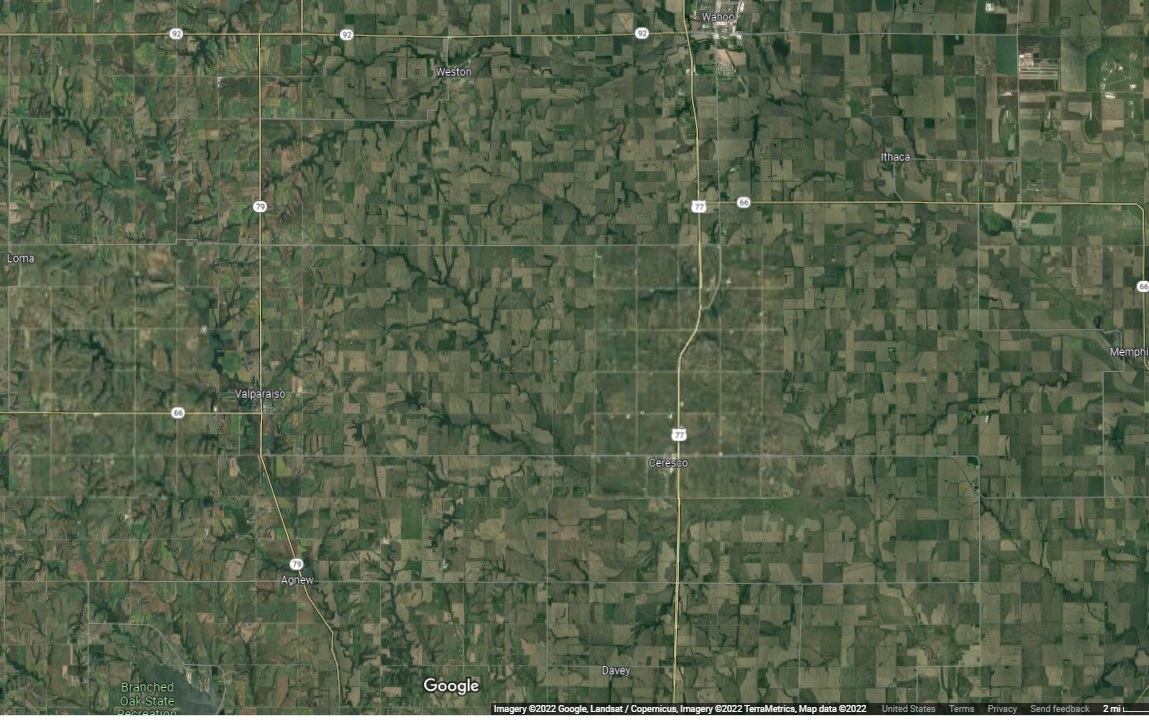
One of the things that changed across Iowa and Nebraska was how the land was used. In Iowa, the square fields were uniform, as you can see from this shot from Google Maps, with roads running along the section lines. (Unlike the east, where boundaries followed natural features like creeks and hills, human structures like the rock walls farmers built, or in the case of Boston streets, cow paths; land in the Midwest was taken from the Indigenous owners who held it without borders, and divided up into squares that were sold to Europeans, who believed land could be owned.)
Once across the Mississippi, there was a change. First, to differences in the use of the fields.
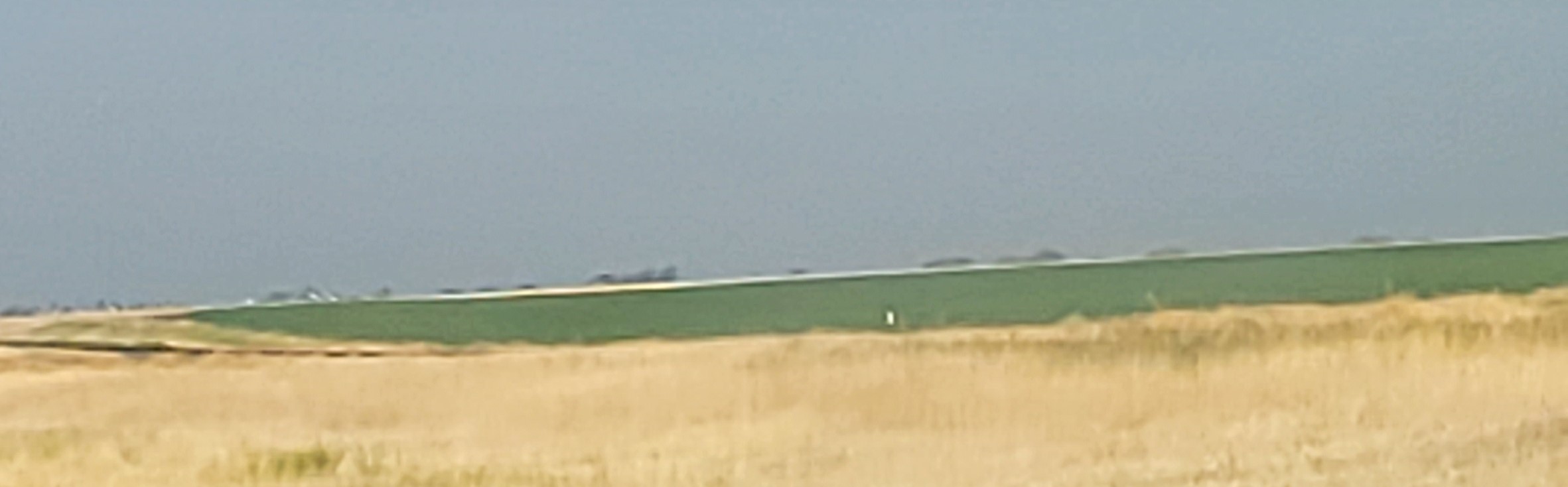
And then, from rectangles to circles where the land is irrigated with center pivots.
Moving southeast, the land goes from cultivation
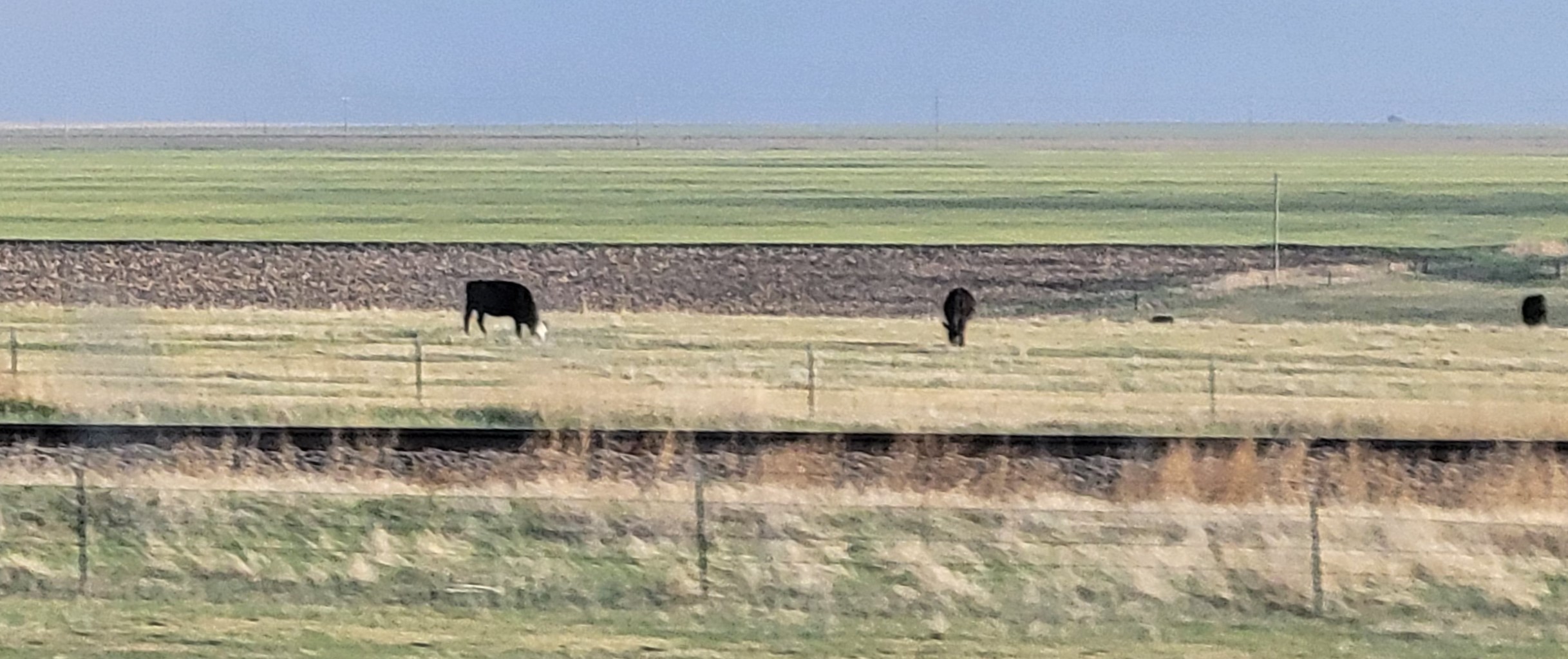
to pasture.
Throughout these posts, I will apologize for the quality of the photos. They were only meant as notes for writing these essays, but sometimes even bad photos are more effective than words.
The change across this section of the country—from green, rectangular fields, to green circles in brown fields, to brown pasture—is indicative of water availability. As a child of the Great Lakes region, I am used to water. Sure, yesterday and today, the humidity made me want to curl up in a ball and sleep until October, but I appreciate the abundance and respect the gift. In the western plains, water isn’t abundant, and irrigation has become essential to the agricultural economy. Water has become scarcer throughout the west, including the Mississippi basin. It’s clear that there has to be a change…but that’s another topic.
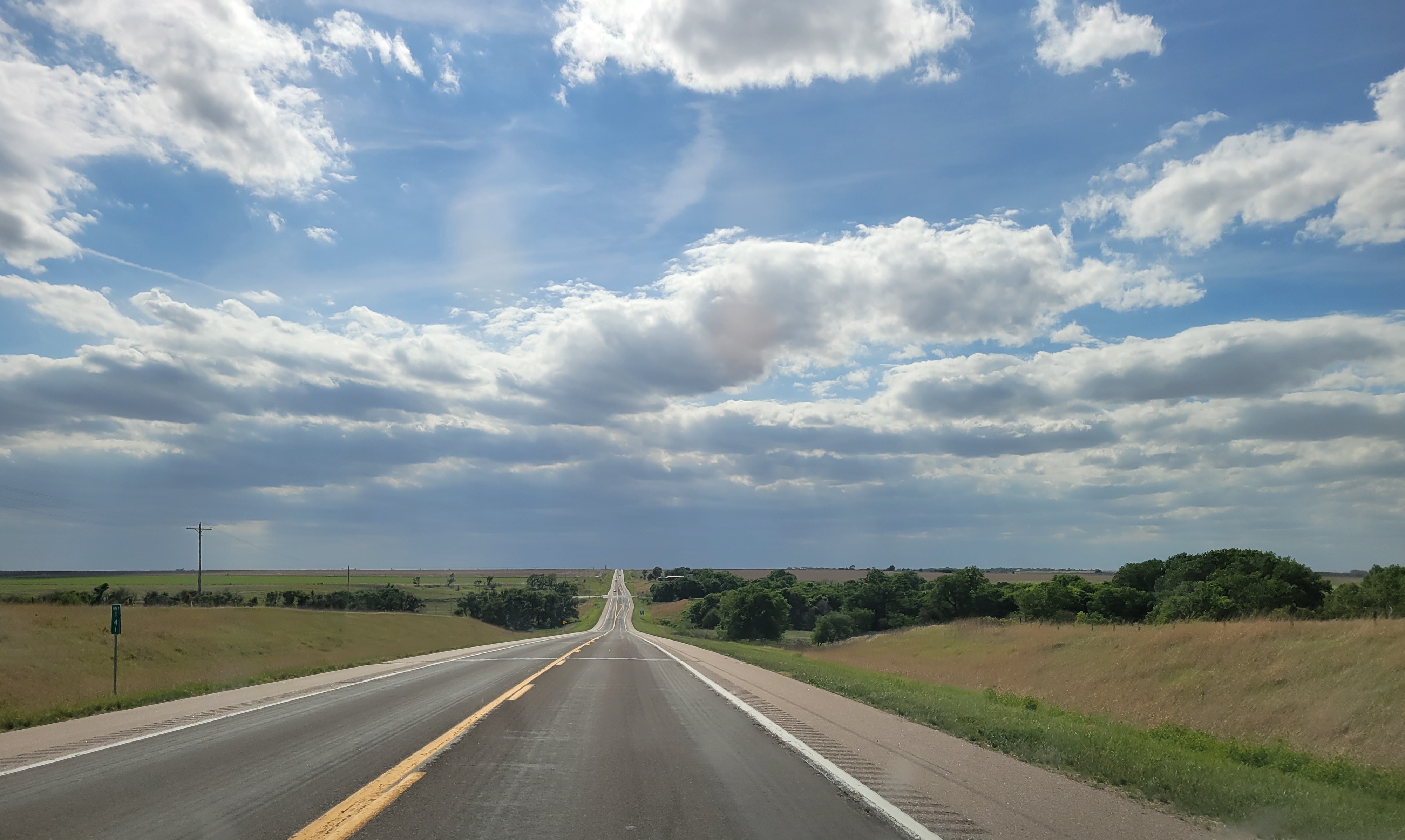
There are a couple of things that aren’t related to the landscape worth noting. First, the speed limit increased as I went west, from 65 to 70, then 75, and finally 80. I was driving long distances and feared the higher speeds would be daunting. Ironically, the actual speed wasn’t very different. Sure, some people were going 85 in an 80 MPH zone, but there were also people doing 75, the speed I usually go in the 65 MPH zones on eastern Interstates. And in the places where people were going fast, there was very little traffic and long sight distances.
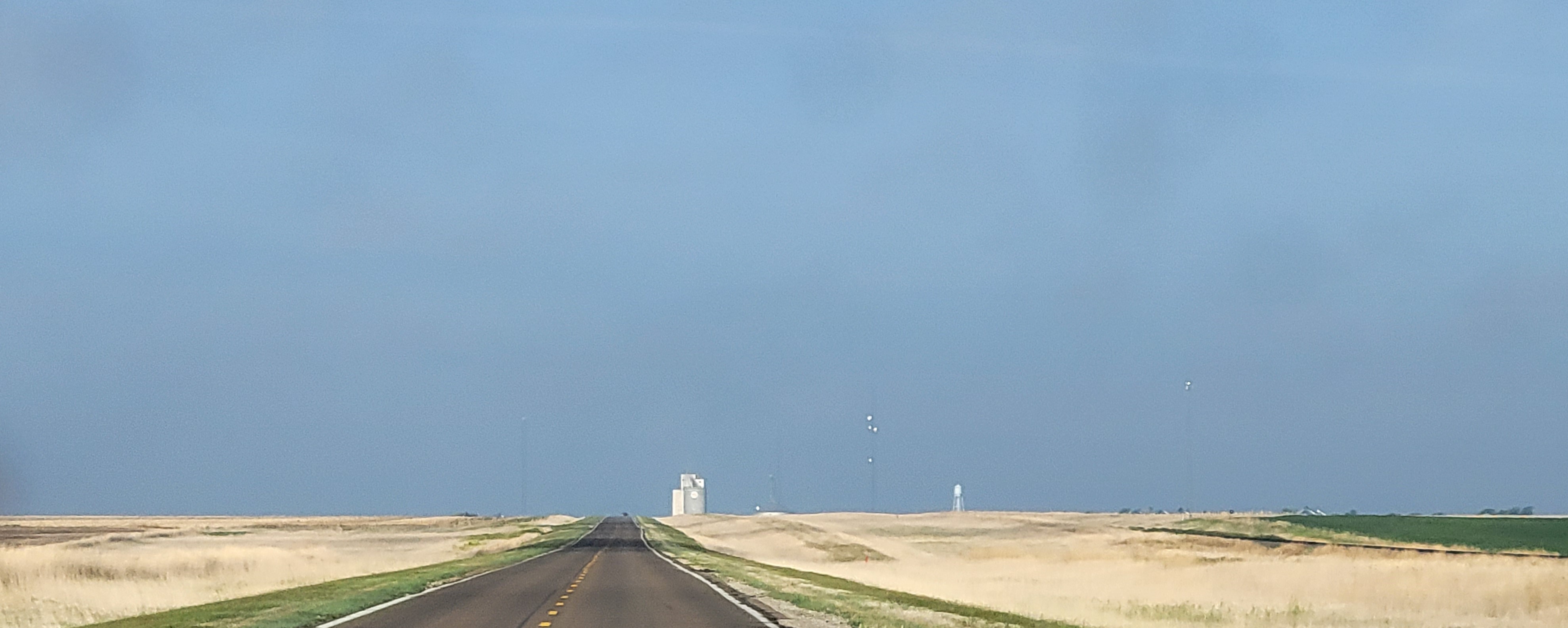
Second, there aren’t many people on the western plains. I took most of these photos out the car window and cropped the road out of some of them. Note, though, in the first photo that I’m on a major two-lane highway, and there are no cars in sight. For every car I saw on the Interstates in the western plains, there were 5 tractor-trailers. In the 250 miles across western KS and southeastern CO, half a dozen cars passed me, and I passed one or two.
Part of this lack of people is due to the reduction in people required to farm in the Midwest. One of the most iconic scenes in this area is the tiny hamlets around the grain elevators.
They appear like castles on the horizon, miles before you can see the town around them. They reflect the economy of the place—an elevator with peeling paint; a gas station, store, and restaurant all closed down. There are usually about 30 – 50 houses, and many are vacant. I thought I had some photos of one of the hamlets, but I don’t.
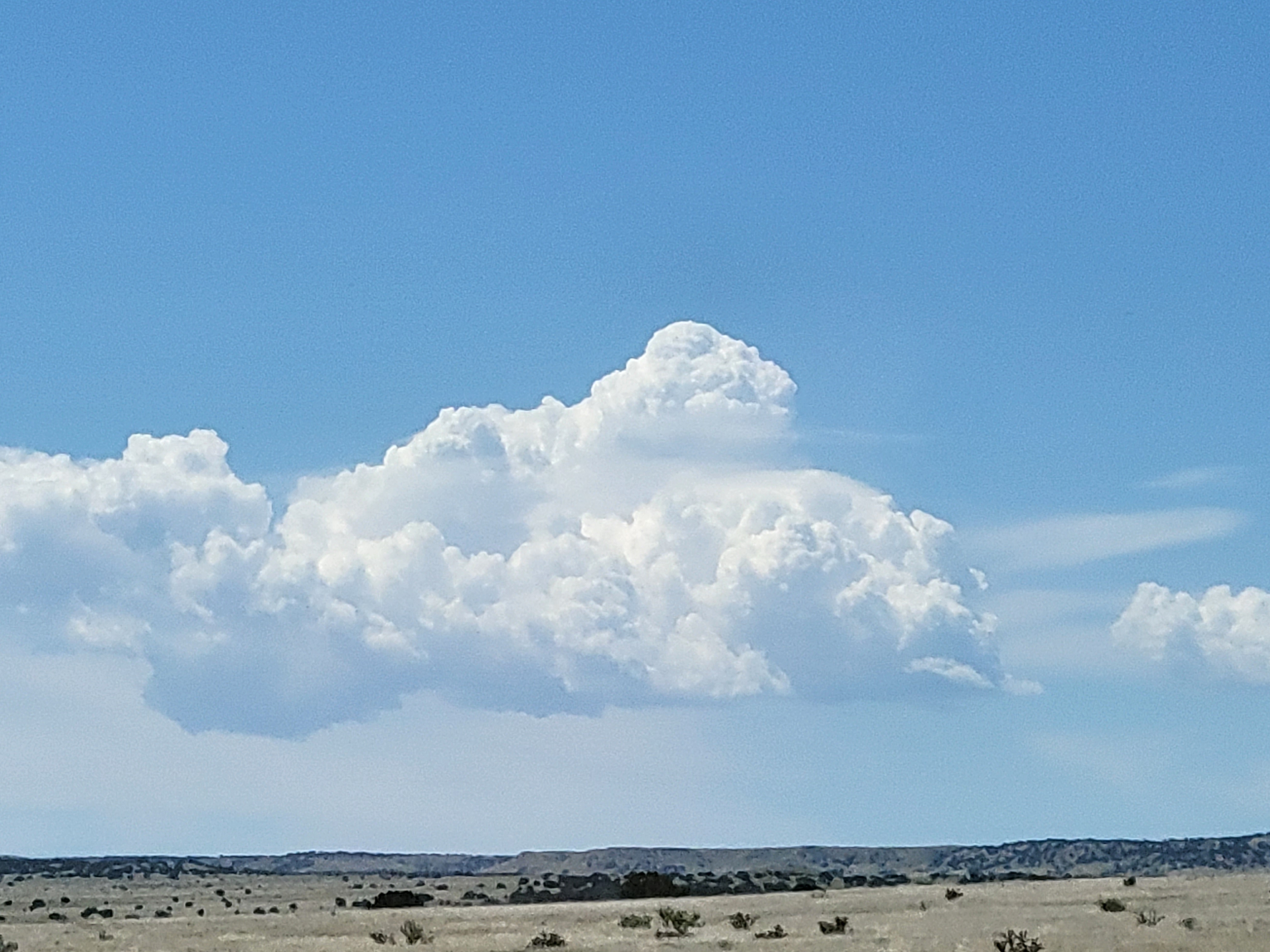
One of the most impressive things in big sky country is the clouds.
By now, the plains have become very dry, as any moisture in the prevailing west winds has been rained out as the air rose over the Rockies and other western ranges. Finally, those mountains appeared.
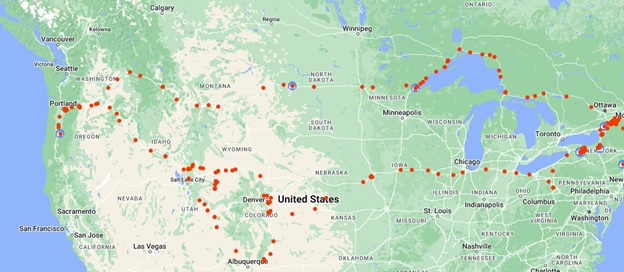
For short periods in my life, I have been without a dog. While I have been fortunate that many people have taken care of my dogs when I’m gone, I find the intercanum period (my term for the period between dogs, from interregnum) a good time to travel. When Angus passed last November, I figured it was time for a road trip. I had a workshop scheduled for early June in Omaha, and that seemed like a good place to start. The map below is an overview of where I went.
A map of my stops, thanks to Google Timeline.
I call this my “Partial Survey of American Landscapes” because the focus is on geography. There were plenty of interesting people and human constructions along the way, but it was the land that fascinated me this time. It started when I pulled out of my driveway and started down Route 11 towards Potsdam. It’s a trip so familiar that I take it for granted. This time, I really noticed things: The pale-yellow green of spring foliage, the wetlands between Potsdam Village and the Potsdam-Morley Rd, and the long view southeast from Windy Acres almost to the Cowan Rd.
I am a voracious listener of books and usually have one playing while driving. It wasn’t until leaving the Appalachians and starting across the plains of Indiana that it occurred to me that it was distracting me from really seeing the landscape. Perhaps it was because the plains of Indiana and Illinois are so flat that more concentration was needed to take them in, but I didn’t listen to anything for the rest of the trip.
Some of the realizations I came to were:
There are no uninteresting landscapes except those desecrated by humans: The gentle roll of the ranges of Kansas may require viewing at a finer scale than the grand vistas of the western mountains, but I found myself mesmerized by them;
Landscapes cannot be viewed independently of the weather, light, and people;
Photographs (particularly mine) cannot capture the place, but I took a thousand as notes about where I was;
28 days is a long time to be away from my roots;
I can drive over 700 miles in a day, but just because I don’t feel fatigued, I am; and
The biggest lie I tell myself (and the one I always forget is a lie) is, “I’ll remember that.”
This is the first of a series of essays about my journey. I hope you enjoy it and the rest of the series. Please feel free to post comments and share anecdotes here. I’ve chosen to post these writings on my blog and link them to Facebook to maintain an illusion of control over their fate.
Acknowledgments
The sections that follow aren’t a travelogue but are about the landscapes. I would be remiss, though, if I didn’t acknowledge the people who made the trip complete by providing human joy: Tyler and Liz, whose hospitality and conversation set the tone for the journey. My mentors at the building controls workshop in Omaha fed me four semesters’ worth of information in four days and tolerated my wisecracks and digressions while at the same time encouraging me in the Quixotic task of developing a program in something I know very little about. Louise and John who shared their home, life, dogs, and food with me in the shadow of the Hermit’s Peak fire in New Mexico. Gordon who opened his home to me (even though he wasn’t there) and introduced me, through others sharing his home, to the culture of fishing guides. Emma who shared her apartment, life, and love of the wilds with me, making me feel both young and old at the same time. Nina who gave me dinner with two of her lovely children, a bed in her cool basement (it was 100 F when I arrived), and stories of our time as teenagers in Quebec. Catherine and her family who gave us lunch and welcome in Denver. Betsy and Bruce who hosted us for three days and took us into the Garden of the Gods in Colorado Springs. William who put us up for four days in Boring, OR (near Portland and sister city of Dull, Scotland), and extracted very little work (a quick roofing job) in return. My high school partner in crime, Mike, whose home in Pleasant Hill, OR, has beautiful gardens and orchards, and soon will sport a performance stage. And, of course, Veigh, who joined me in Denver and tolerated my idiosyncrasies for two weeks.
I do not like living in a country so full of hate. It’s not a new realization. Our country, our government, sent troops and covert operatives to Vietnam, Afghanistan, Iraq, and many other countries to kill people on their own soil.
I moved to northern New York on the Canadian border because my draft number was 12, and I was determined to go to Canada rather than Vietnam. I found that I loved this community and have lived here most of the last 49 years.
The internal strife of the 60s and 70s over the Vietnam war took years to heal. Internal strife over environmental regulation has become less polarized but remains. Today’s strife seems different. Among other things, it was created by the media rather than the events being covered. It is also the product of the long game that started in the 80s when Grover Norquist introduced through Reagan, a new approach to reducing the size of government: Don’t worry about cutting programs, but cut taxes and the programs will starve.
Along the way, conservatives took up the mantles of conservative Christianity, abortion, and gun rights, not because they fit the program they were promoting but because they brought in new supporters. I believe that the crowning achievement of the Republican party has been to convince people to vote against their own self-interest.
CNN ushered in the era of the 24-hour news cycle. Before that, we watched four network news shows—NBC, ABC, CBS, and PBS. These were only 30 minutes, and their point-of-view was subtle but similar. Enter Fox News. As one protester’s sign read: “Fox News: Rich people paying rich people to tell the middle class to blame the poor.” And immigrants. And people of color. Muslims.
And so, I sometimes wonder if I should have moved to Canada. Its policies reflect my values. I once met some loutish Canadians, but for the most part, they are a much more civil society. When there was a mass shooting in Toronto a few years ago, the shooter was talked down and arrested, not killed.
I am a selfish person, though; my roots in this community—even in this country—are deep. I don’t regret staying. I would like to think I’ve made a small contribution to making my community and my country a better place, but I know it is minuscule at best. And who is to judge what is a “better” community or country? That is a topic for another essay.














 Robin McClellan