Night at the Bear

After the distillery, I headed to Bear on the Lake Hostel on the Bras d’Or lakes. It was described in the Lonely Planet guide as a “super-fun place overlooking the lake.” It is a backpacker’s hostel where people come to meet. This is as opposed to an HI (Hostels International) hostel where people come to sleep cheap, go to bed early and find the majority of their entertainment outside the hostel. Both have their advantages but I wanted to start with a “super fun” crowd.

After a meal at the Red Shoe Pub—a lovely little place in Mabou owned by the Rankin Sisters of Rankin Family fame—I drove over to the Bear. I was met by Carmen, the “effervescent” (according to the Lonely Planet) owner, and told there was, indeed, room. I started to try to work on a grant proposal I hadn’t finished, but was quickly distracted by the guests from Belgium, Germany, Australia and Canada. Someone brought out a bottle of wine and we started talking about energy and sustainability and, after accepting too many offers of wine, I looked up my favorite TED talk and started lecturing. How embarrassing! I finally went to bed and probably kept the whole room up with my snoring.

The Red Shoe Pub. Doesn't look too Celtic!

The Red Shoe Pub. Doesn’t look too Celtic!

Leave a comment

Filed under Nova Scotia, July 2013

Glenora Distillery

So you know that I couldn’t visit Cape Breton without visiting the only single-malt whiskey (you can’t call it “Scotch” unless it’s made in Scotland) distillery in North America. And it was fascinating!

Glenora Distillery was founded here, near Mabou, because of the water. The water comes down off the highlands in a good sized stream but they have to pump it into a holding pond so they have the 2,000 gallons they need to mash the barley. The mash tun is huge compared to the breweries I’ve seen. The mash process is much the same as beer though, temperature is held at about 160 F and paddles mix the mash while a pump recirculates it so the finer particles aggregate on the bottom to form a filter. The liquid from the mash, now called “wort,” is cooled while it is pumped into 3 different wooden fermentation vessels that look like huge hot tubs…but 12 feet deep.

Fermentation vats with the copper mash tun in the background

Fermentation vats with the copper mash tun in the background

Yeast is added and the fermentation starts in earnest. One difference here is that the fermentation is “open” and there’s not even a cover over the vessels. They can do this because they don’t aim for high attenuation (the amount of sugar that is turned into alcohol). Instead, they move the wort to the still before all the sugar is fermented. The initial fermentation is so vigorous that the CO2 forms a layer that keeps oxygen out and preventing the formation of vinegar.

The "Spirit Still" for the final distillation with the "Spirit Safe" in the background

The “Spirit Still” for the final distillation with the “Spirit Safe” in the background

Once the liquor is in the first still, it is distilled and ends up with an alcohol content of somewhere in the 25 – 30%. It is transferred to the second still where the results are in the 60 – 65% range. This distillate is stored in the “spirit safe.” Traditionally, this was locked and only excise agent (the “revenuer,” in southern moonshine parlance) had a key. He would ascertain the volume and the “proof” which determined the tax the producer owed. In this, more trusting, environment, the distillery reports its own figures.

From there, the liquor is filtered into casks which are sealed, marked with the date and a number, and moved to the warehouse. These casks are stored in uncontrolled conditions for at least 10 years. At the end of 10 years, the casks may be opened and the whiskey bottled. They may also continue in storage, with the mellowing process continuing for up to 19 years. Although some single malts are aged longer, the chance of improving in taste is diminished while the chance of degradation of flavor is increased.

Robin bottling a 17 year old, cask strength single malt

Robin bottling a 17 year old, cask strength single malt

3 Comments

Filed under Nova Scotia, July 2013

Landing

It used to be when I began a trip, I would build up a head of steam. When I arrived, I would keep going from place to place for a few days before I settled down and started absorbing the place I was. As I’ve gotten older, I tend to settle much faster.

New Brunswick kitsch

New Brunswick kitsch

I left Fredericton this morning and drove straight through to Cape Breton…and directly to the Glenora Distillery. It was a fascinating tour and the Scotch was Lowland (no peat), but quite drinkable. I’ll post more about it separately.

There is something special about the land here. It’s similar to northern NY, but there’s something different. For one thing, the sea is nearby now and there are some great tidal areas. The view from the visitors’ center just inside NS from NB is quite beautiful.

The view from Visitor's Center at the Nova Scotia/New Brunswick border.

The view from Visitor’s Center at the Nova Scotia/New Brunswick border.

I ran into the first construction delay on the Canso Causeway to Cape Breton–only 10 minutes or so–and it gave me to time to gape at the cliffside that has been sacrificed to build and maintain the causeway. One cliff face has been chipped away and the crusher and processing equipment remains ready to continue to churn out more crushed stone.

Cape Breton is beautiful! The wooded hills are stunning and there is music everywhere. I spent the first night here at the Bear on the Lake Hostel and it was just what I wanted to do! Belgians, Canadians, a German, and an Aussie all sat around a table, sharing bottles of wine and a bottle of local, cask strength (65% or 120 proof) whiskey.

Leave a comment

Filed under Nova Scotia, July 2013

The long, good road to Fredericton

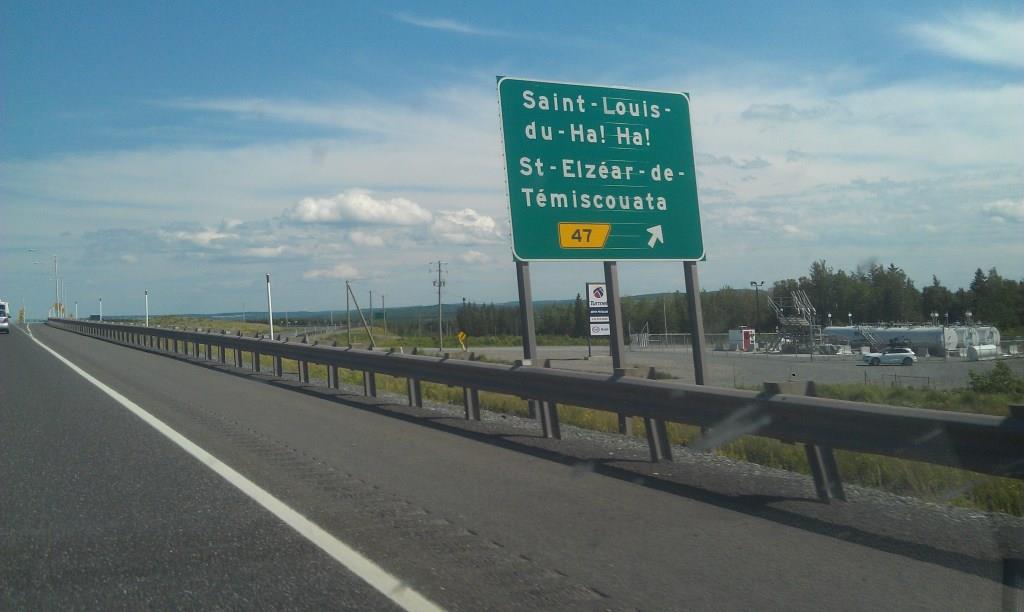
There was a time when 600 miles was nothing. That was a long time ago. But the 600 miles from Potsdam to Fredericton, NB, was a piece of cake. They’ve finished the A-30 south of Montreal so outside of the inevitable construction on either end of A-30, I didn’t even know I was near Montreal. Not much to slow me down from Montreal to Riviere du Loup had only some slight slowing for construction, no stops. Same was true for the rest of the Trans Canada to Fredericton (through, and I’m not making this up, St. Louis du Ha! Ha!)

I love a town with a sense of humor!

I love a town with a sense of humor!

The new 4 lane was a harbinger of what might come to pass in the Adirondacks. The cleared area on either side of the road was wider and there was an 8 foot fence to discourage moose from getting on the roadway. If they do get there, the fence has one way gates so the majestic creatures (with red eyes that don’t shine brightly at night and bodies conveniently located at windshield height of most cars) can get back to safety.

I arrived late in Fredericton and didn’t see much of the city, just drove to the university (that offers low priced accommodation to travelers in the summer) and caught up on email (something I plan to stop doing as soon as I finish the things I didn’t finish before I left). I don’t plan to linger here, although I would love to see the Dali they have in the Lord Beaverbrook (yes, there are a LOT of things in Canada bearing his name, from here all the way to Victoria, BC) Art Gallery. This “sleepy provincial town,” as it is referred to in the Lonely Planet guide, is lovely, but I am determined to spend time in Cape Breton on this trip, so I’m off to Wagmatcook to get acquainted with Mi’kmaq native culture (all I know is they were transported by the colonials to Newfoundland to put down the Beothuks, which they did by effectively killing them all…but that may not be the current historical narrative).

Only 555 km to go today!

Leave a comment

Filed under Nova Scotia, July 2013

Controlling Gun Injury with Gun Control

Introduction

The term “Assault Weapon” was a term coined in the first Federal AWB (Assault Weapons Ban) in 1994. It has been used extensively since then, but the definition is quite vague. In fact, the AWB covered specific makes and models of gun (while specifically allowing others), a sign that the authors were struggling with a functional definition.

In fact “Assault Rifle” is a term that has been used for some time to define what the military uses. A key characteristic of an “Assault Rifle” is the ability to fire more than 1 cartridge per trigger pull, in other words, a “fully automatic” or “burst fire” rifle. These rifles may also have barrel shorter than 16” or be less than 26” in length (with stock fully extended). These are currently banned except for licensed holders by the National Firearm Acts of 1934 and 1968.

The AWB focuses on rifles that look like “Assault Rifles” but are not functionally equivalent. Most gun manufacturers have developed “street legal” models of their assault rifles that are similar but are semi-automatic and have barrels and overall lengths that meet the 1968 NFA standards.

One of the questions that is often heard is, “Why would anyone need a gun like that?” Interestingly, that’s not a question that is asked about cars that are designed to go twice the speed limit. The question is, “What limitations to guns and gun ownership would limit gun injury and particularly gun violence, while minimizing the impact on law abiding gun owners?”

Limiting Guns

Magazine capacity

Limiting magazine capacity can limit the rate at which a gun can be fired. No matter how fast you can change a magazine (and with practice, this can be pretty fast), it still requires the shooter to stop shooting. In the case of mass shootings, this could limit the number of people shot. But I don’t see how it would limit the number of mass-shootings. Would a potential mass shooter decide not to carry out his plan because 30 round magazines were illegal?

Changing the limit from 30 to 10 could have an impact in this regard, but changing the limit from 10 to 7, seems arbitrary. Allowing 10 round magazines but limiting the number of rounds legally contained is senseless. Would a shooter choose not to exceed the 7 round limit if he were planning carrying out a mass shooting?

Other functionalities

The AWB also addressed 5 other characteristics in the “2 of the following 5” definition that finds a rifle is illegal if it has 2 of the following 5 characteristics:

  1. Grenade launchers – It seems like a no-brainer: we aren’t allowed to have grenades, why should we have launchers? But since we can’t legally own grenades, why NOT allow launchers? (To my knowledge, no mass killing by civilians have been carried out in this country using rocket propelled grenades despite the fact the grenade launchers are legal under federal law).
  2. Bayonet mount – Very popular in WWI, but not so much these days. Allowing them for historical military guns would make sense. (To my knowledge, no mass killings by civilians have been carried out in this country using a bayonet after the gun jammed or the ammunition ran out).
  3. Flash suppressor or threaded for a flash suppressor – This is another area where the law is being preemptive. It’s not the flash suppressor, but the threading that would allow a silencer to be mounted that seems to be at issue. Silencers are banned under the 1968 NFA.
  4. Folding or telescoping stock – I’m not sure what functionality is being addressed here. Is it because they are easier to conceal or is it just because they make them look more like military weapons?
  5. Pistol grip that extends conspicuously below the action (now including thumbholes!) – ??? I have NO idea what this has to do with anything!

By make and model

Further evidence that the authors of the AWB were unfamiliar with the firearms addressed is the portion of the bill that lists specific makes and models of weapons that are banned under this bill and specific weapons that are exempted. If the definitions in the bill were clear and functional (as they were in the 1968 NFA), this would not have been necessary.

Limiting Gun Ownership

For better or for worse, the 2nd Amendment is still the law of the land. The Supreme Court has issued several opinions in the last few years that make it clear that it is not constitutional to limit gun ownership to everyone, but it has also been clear that it is constitutional to limit gun ownership to specific classes of people (e.g., felons, people convicted or domestic violence, etc.). In addition, the Court has not struck down State gun registries like New York’s system of permitting handguns.

If laws are going to be preventative, it’s probably not enough just to put a law in place that includes higher penalties for people who commit gun crime if they are legally restricted from owning a gun. Better that we should put procedures in place to prevent those people from obtaining a gun in the first place. Background checks would go some way to limit the ability of this class of citizen from legally obtaining a firearm.

It would require, however, better buy in and cooperation from the States. The current NICS check is not as effective as it should be because many states don’t upload information. The NICS also gets into the slippery area of who can be banned. If I’ve seen a counselor for marital problems, does that constitute a mental illness that would preclude gun ownership? What about non-violent crimes or depression?

A more effective but more expensive and controversial way to insure that guns don’t fall into the hands of people who are banned from owning them is a gun registry. This is a massive project and would take years to bear fruit. At the current time, there is no stomach for such an undertaking. Even in Canada where attitudes towards guns are much more restrictive, the attempt to register long guns failed.

Currently the Federal government permits and registers machine guns, short-barreled rifles, short-barreled shotguns, suppressors (silencers), destructive devices (grenades, bombs, missiles, poison pens, etc.) and another catchall category, “Any Other Weapon” which picks up a lot of exceptions such as “cane guns,” “smooth bore pistols,” disguised firearms, etc.. This program charges very high fees, $200, for transferring these firearms between permitted owners. In addition, the permits are difficult and expensive to obtain.

Other

Some other regulations that are not currently being contemplated seem like they would have a much greater impact on gun injury. First, requiring all guns be stored safely would probably go the farthest to reduce gun injury and gun violence. A significant amount of gun violence involves stolen weapons. Securing guns so they can’t be stolen can reduce the availability of stolen weapons as well as keeping guns out of the hands of unsupervised children. New York’s recent gun law requires safe storage only if someone living on the premises is prohibited by law from owning a gun (a felon, someone convicted of domestic violence, etc.).

Requiring more extensive training for permitting handguns in New York could make a difference. No training is required in New York State to obtain a pistol permit. Would this lower crime? Probably not, but it might lower other gun injuries.

The gun lobby pressured Congress to not only pull but prohibit federal funding of studies into gun injuries. The same amendment limits how gun crime statistics are reported by the FBI. This is kept us and the lawmakers in the dark, leading to bills that address the real problem of gun violence with their gut rather than their head.

A Note on Ammunition

During the recent debate on gun control, there has been some discussion of limiting access to “military ammunition.” The thought is that somehow military ammunition is more dangerous than ammunition used for hunting. Nothing could be farther from the case! Military rounds are “full metal jacket” which jacket the lead bullet completely in copper and keep it from expanding on impact. For over a hundred years the Hague Convention (1899) bans the use “expanding” bullets. Expanding bullets (e.g., “soft point” and “hollow point”) are designed to open up once they are inside the target to maximize the damage, increasing the lethality of the round.” In hunting, this reduces wounding of animals and decreases suffering. The bottom line: hunting ammunition is far more lethal than military ammunition!

The Current Debate

Debate around gun control is different than the debate around other crime. Much of this has to do with fact that we have a constitutionally protected right to gun ownership, but less than half the households in the country own a gun. As I noted in the opening, we talk about guns in very different ways than we talk about other things we own that are as deadly. Worldwide, 31% of traffic fatalities are due to excessive speed. In the US, that equated to about 14,000 in 2005. That same year there were 18,697 homicides, 11,346 were carried out with guns. Of that number, 8,478 were handguns.

There is no getting around the fact that guns were designed to kill and vehicles weren’t, but the limits we place on vehicles travelling on public roads is based on functionality and safety, not character. We don’t say, “Who needs a 300 HP car on the street?”and attempt to ban 300 HP cars…or at least the ones that have racing stripes.

Until there is some data and a willingness to apply statistics rather than emotion to the issue, we will end up with ineffective and polarizing laws that serve no one.

Leave a comment

Filed under Gun Violence

A House Concert for the Record

Paul Meyers, Guitar

Bret Zvacek, trombone

John Geggie, bass

“It Might as Well be Spring” is the theme  –  it’s a great tune, and a little wishful thinking goes a long way… 😉

Wednesday, March 20, 7 PM

Robin McClellan’s house in Sanfordville.

Paul Meyers will be playing a concert with two wonderful musicians who are both on the Crane faculty. Bret Zvacek, trombone, and John Geggie, bass, are two fantastic jazz players that Paul had the pleasure of working with as a group only once before. They had a fantastic time then and they are all looking forward to reuniting to perform their arrangements of Spring related tunes from the Great American Songbook (such as Spring is Here, Spring can Really Hang You Up the Most, and our theme song, It Might as Well be Spring) along with jazz standards (Joy Spring by Clifford Brown, Up Jumped Spring by Freddie Hubbard) and more.

AND Joel Hurd from North Country Public Radio is coming out to record the concert for a CD – so if you’re there, you will also be on the CD! Join this wonderful trio at Robin McClellan’s house in Sanfordville where Paul has played several times before in the past two years. There will be some light refreshments, but feel free to bring your own.

Admission: $10

 Personnel

Bret Zvacek (trombone) has performed with Kenny Wheeler, Gene Bertoncini, The Woody Herman Orchestra, and numerous other jazz artists. Since September 2005, Bret has served as the Musical Director of the Central New York Jazz Orchestra (Syracuse), collaborating with artists including Phil Woods, Hubert Laws, Bobby Watson, Joe Locke, and others. Under Bret’s direction, the CNYJO has released its first CD/DVD “THEN, NOW & AGAIN” to critical acclaim. Bret’s 2001 quintet CD “DAY IN MAY” has been described as being “infused with creative energy” (Cadence Magazine, December 2002). He has written big band music for numerous professional and student ensembles. He has held teaching positions at University of North Texas, McGill University, and at The Crane School of Music in Potsdam, NY, where he currently is Professor of Music and Director of Jazz Studies He is a clinician and performing artist for the Yamaha Corporation of America, and conducted the New York All-State Jazz Ensemble in December 2007, and the Massachusetts All-State Jazz Ensemble in March 2009. Get Bret Zvacek Quintet DAY IN MAY and CNY Jazz Orchestra THEN, NOW & AGAIN at cdbaby.com & iTunes music store.

You can find out more about Bret and hear some of his music at http://www.cdbaby.com/cd/zvacek, http://www.myspace.com/bretzvacek and http://bretzvacek.com/.

John Geggie is greatly in demand as a versatile musician (double bassist) and creative composer both in Canada and internationally. He has been the curator and programming director of the Geggie Series for thirteen years. For over ten years, he has hosted the Late Night Jam Sessions at the Ottawa International Jazz Festival. He has also toured extensively with the award-winning jazz group Chelsea Bridge and the JUNO-nominated D.D. Jackson Trio. He has also recorded or performed with a many of the top names in creative improvised music: Jon Christensen, Ron Miles, Joel Frahm, Andy Milne, Marc Copeland, Vic Juris, Ben Monder, George Colligan, Craig Taborn, Sheila Jordan, David Murray, Andrew Cyrille, Donny McCaslin, Matt Brubeck, Ted Nash, Billy Hart, Marilyn Crispell, Myra Melford, Bill Carrothers, Cuong Vu and bassist, Mark Dresser. Previously, he has performed at various international festivals including in Rouen and Maubeuge (France), in Molde (Norway) and throughout the United States. Geggie has also participated in the Ottawa International Chamber Music Festival. In addition, he continues to maintain a busy concert schedule with the 13 Strings Chamber Ensemble and is involved in many recording projects. He performs regularly with the National Arts Centre Orchestra. John is on faculty at the Crane School of Music, State University of New York (SUNY Potsdam) and has students at both Carleton University as well as University of Ottawa. This winter, the Thirteen String Chamber Orchestra premiered his most recent composition, St.Andrews’ Vibrations as part of their 2012-201 season.

You can find out more about John and his music at johngeggie.com (although he assures me it’s nothing like what they are going to be playing together!).

Paul Meyers – “one of the most eloquent jazz guitarists since Kenny Burrell”  –  James Gavin, NY Times – Paul is already familiar to many  music fans in the North Country through many performances there over the years. He has gained a reputation as one of the top jazz guitarists of our time. Paul has performed and recorded with an ever growing list af jazz greats – Geri Allen, Karrin Allyson, Kenny Barron, Bruce Barth, Ron Carter, Eliane Elias, Eddie Gomez, Jovino Santos Neto, Rufus Reid, Claudio Roditi, Annie Ross and David Sanchez to name a few. He’s also toured worldwide for many years with two of the greatest jazz singers ever – Jon Hendricks (since 1993) and Andy Bey (from 1997 to 2008). Paul performed in Argentina and the US with vibraphonist Gary Burton, who recorded Paul’s tune Panama on his “Reunion” CD with Pat Metheny. He has a number of critically acclaimed CDs including World on a String, a quintet with rising stars Donny McCaslin and Helio Alves, featuring Paul’s original compositions and arrangements, and Paul Meyers Quartet featuring Frank Wess, a relaxed straight ahead session with the legendary tenor and flute master. He has also recorded 4 solo guitar CDs including Welcome Home  (2011), a highly acclaimed CD of all original music. Paul teaches jazz guitar, improvisation and coaches jazz and Brazilian ensembles at William Patterson University and at New Jersey City University and he also taught at the first year of the Jazz for Teens program at NJPAC in Newark.

Paul’s web site has more about him and you can listen to some of his music at www.paulmeyers.info/live/

Leave a comment

Filed under House Concerts

The “RE-stock”

 “RE-stock” Concert Series to benefit St. Lawrence County Food Pantries. Featuring music by Rick Bates (aka Tas Cru) & Mary Ann Casale along with special guests.

Rick Bates is a blues artist and songwriter, whose latest album, Tired of Bluesmen Cryin’ has made its way on to the international/national roots music charts. Recent appearances include BB King’s and the Rum Boogie Cafe in Memphis, TN. Mary Ann Casale is a singer/songwriter with a strong influence from her roots in the New York City folk scene in the mid-seventies. She started playing the coffeehouse circuit in New York State and Colorado as a solo performer and a vocalist in a number of bands. Their unique blend of folk/blues Americana was born out of their shared experiences as young musicians when they met in Potsdam nearly 30 years ago. They have been waiting these 30 years to perform together again!

All concerts begin at 7pm

Admission is a $10 donation or non-perishable food items.

Concert Dates:

Friday 3/8 Robin McClellan House Concert – 465 Old Market Road, Sandfordville, NY

Friday 4/5 Canton Unitarian Universalist Church

Friday 5/10 Massena Chamber of Commerce W. Orvis St


Sponsored and Supported by Robin McClellan, Canton Unitarian Universalist Church and the Massena Chamber of Commerce  – further info contact ktbluesmanagement@gmail.com Phone 315.262.5989

Leave a comment

Filed under House Concerts

Death in the Time of Zealotry

I recently read an article summarizing recent accusations of euthanasia against palliative care providers. Half of the respondents to a recent survey reported such accusations. 4% of these providers were investigated and no criminal charges have been upheld. It’s understandable that some of those accusations come from immediate family who, despite the wishes of the patient, want to prolong their life. What’s much more disturbing is that members of the health care team providing care to the patient were among the accusers.

It is unclear to me how much of this is a misunderstanding of current health care laws regarding living wills and how much of it is a social backlash. Clearly the latter exists with the highest profile examples being the Terri Schiavo case (where the courts intervened numerous times over the removal of her feeding tube when she was found to be in a vegetative state) and the more recent characterization of the Affordable Health Care Act’s panels that advised on end of life options as “death panels” by opponents.

The United States has always had a secular government but strong religious communities. Until now, though, abortion seemed to be the primary issue where religion and government interacted. In the last 20 years, though, this has changed and the country that was founded by people bent on religious freedom is threatened by religious fundamentalists of all stripes. It is supremely ironic to me that the same people who excoriate Muslims for the violent acts of a few now want their view of religion and morality enshrined in law. The same people who claim to be the protectors of the rights of the individual (corporation) are the same people who support limits on marriage and even on care of the dying.

It is my sincere hope that the rights and freedoms our forebears fought and died for are not swept away in this tide of religious zealotry.

1 Comment

Filed under Health Care

Energy Efficiency: Rearranging the Deck Chairs on the Titanic

In “Is Efficiency Sufficient?” (prepared for the European Council for an Energy Efficient Economy, eceee, with funding from the European Climate Foundation and the U.S. Environmental Protection Agency’s ENERGY STAR Program), Chis Calwell notes that we’ve successfully increased efficiency, but energy loads are increasing. We could start a Manhattan project for efficiency, but unless we have a serious cultural shift in our approach not only to energy but to material, we will continue our trend to increased energy consumption.

The elephant in the living room is, well, the living room! When I was growing up we had a huge black & white TV in the living room. The lights dimmed when it came on, it took two and a half minutes to warm up and baked the paint off the shelf above it. But we turned it on a half hour a day (well, an hour on Sundays, for “Lassie” and “Walt Disney Presents,” the show before the “Wide World of Color”).

Free market capitalism runs on gains not reductions. If we are to rely on the market for solutions, there must be some real economic gain for reduction that is greater than cost reduction. In today’s world that would mean a sliding scale for energy that is opposite of what we have now: paying less per kWh for electricity if you use less rather than less if you use more. This certainly isn’t the “natural” order of free market, the free market relies on scarcity to increase price across the board. In Europe, they’ve increased the cost of energy “artificially” through taxes, acknowledging that the free market is severely short-sighted. In this country our gasoline taxes are going down as percentage of the cost because they are levied per gallon rather than per dollar. And there is no one who would suggest raising those taxes if we can’t raise taxes on the wealthy.

To a large extent this is also biological. Natural selection has favored those in our species that have amassed wealth, first in the form of stored food, now in the form of a much broader array of material—TVs, automobiles, computers, weapons, etc.—but the future of the status quo, if not the species, relies on cooperation. Perhaps if we can get our big brains to override our reptilian ones in this regard, we’ll be able to turn around. Otherwise we may be in for the most Malthusian of population curves.

Whenever I write something like this I ask myself, “How in the world does this help?” I’m not sure. I’m a “glass half full” kind of guy, though. I’ve seen this kind of trend before and often it ends with an abrupt shift when there is some kind of catalytic event. So I remain optimistic that a catalytic event will preclude an apocalyptic one.

1 Comment

Filed under Economy, Energy

Leaving Paradise

March 7, 2012 7:10 PM Kahului

Time flies like an arrow (and fruit flies like a banana). Mau’i is a beautiful place even though it was overcast and windy. I realized that I have seen much of the island and this was a time to enjoy the company of good friends. We went out in the boat and saw whales; we walked dogs; we sat at the computer and looked at photos from our past.

It’s not a bad thing to have a bucket list, but often times it’s the little things–the personal connections that we don’t think of or take for granted–that are the important things.

Aloha!

Leave a comment

Filed under Hawai'i - 2012