Death in the Time of Zealotry

I recently read an article summarizing recent accusations of euthanasia against palliative care providers. Half of the respondents to a recent survey reported such accusations. 4% of these providers were investigated and no criminal charges have been upheld. It’s understandable that some of those accusations come from immediate family who, despite the wishes of the patient, want to prolong their life. What’s much more disturbing is that members of the health care team providing care to the patient were among the accusers.

It is unclear to me how much of this is a misunderstanding of current health care laws regarding living wills and how much of it is a social backlash. Clearly the latter exists with the highest profile examples being the Terri Schiavo case (where the courts intervened numerous times over the removal of her feeding tube when she was found to be in a vegetative state) and the more recent characterization of the Affordable Health Care Act’s panels that advised on end of life options as “death panels” by opponents.

The United States has always had a secular government but strong religious communities. Until now, though, abortion seemed to be the primary issue where religion and government interacted. In the last 20 years, though, this has changed and the country that was founded by people bent on religious freedom is threatened by religious fundamentalists of all stripes. It is supremely ironic to me that the same people who excoriate Muslims for the violent acts of a few now want their view of religion and morality enshrined in law. The same people who claim to be the protectors of the rights of the individual (corporation) are the same people who support limits on marriage and even on care of the dying.

It is my sincere hope that the rights and freedoms our forebears fought and died for are not swept away in this tide of religious zealotry.


1 Comment

Filed under Health Care

Energy Efficiency: Rearranging the Deck Chairs on the Titanic

In “Is Efficiency Sufficient?” (prepared for the European Council for an Energy Efficient Economy, eceee, with funding from the European Climate Foundation and the U.S. Environmental Protection Agency’s ENERGY STAR Program), Chis Calwell notes that we’ve successfully increased efficiency, but energy loads are increasing. We could start a Manhattan project for efficiency, but unless we have a serious cultural shift in our approach not only to energy but to material, we will continue our trend to increased energy consumption.

The elephant in the living room is, well, the living room! When I was growing up we had a huge black & white TV in the living room. The lights dimmed when it came on, it took two and a half minutes to warm up and baked the paint off the shelf above it. But we turned it on a half hour a day (well, an hour on Sundays, for “Lassie” and “Walt Disney Presents,” the show before the “Wide World of Color”).

Free market capitalism runs on gains not reductions. If we are to rely on the market for solutions, there must be some real economic gain for reduction that is greater than cost reduction. In today’s world that would mean a sliding scale for energy that is opposite of what we have now: paying less per kWh for electricity if you use less rather than less if you use more. This certainly isn’t the “natural” order of free market, the free market relies on scarcity to increase price across the board. In Europe, they’ve increased the cost of energy “artificially” through taxes, acknowledging that the free market is severely short-sighted. In this country our gasoline taxes are going down as percentage of the cost because they are levied per gallon rather than per dollar. And there is no one who would suggest raising those taxes if we can’t raise taxes on the wealthy.

To a large extent this is also biological. Natural selection has favored those in our species that have amassed wealth, first in the form of stored food, now in the form of a much broader array of material—TVs, automobiles, computers, weapons, etc.—but the future of the status quo, if not the species, relies on cooperation. Perhaps if we can get our big brains to override our reptilian ones in this regard, we’ll be able to turn around. Otherwise we may be in for the most Malthusian of population curves.

Whenever I write something like this I ask myself, “How in the world does this help?” I’m not sure. I’m a “glass half full” kind of guy, though. I’ve seen this kind of trend before and often it ends with an abrupt shift when there is some kind of catalytic event. So I remain optimistic that a catalytic event will preclude an apocalyptic one.

1 Comment

Filed under Economy, Energy

Leaving Paradise

March 7, 2012 7:10 PM Kahului

Time flies like an arrow (and fruit flies like a banana). Mau’i is a beautiful place even though it was overcast and windy. I realized that I have seen much of the island and this was a time to enjoy the company of good friends. We went out in the boat and saw whales; we walked dogs; we sat at the computer and looked at photos from our past.

It’s not a bad thing to have a bucket list, but often times it’s the little things–the personal connections that we don’t think of or take for granted–that are the important things.

Aloha!

Leave a comment

Filed under Hawai'i - 2012

A Sense of Peace

March 5, 2012 7:30 AM HST

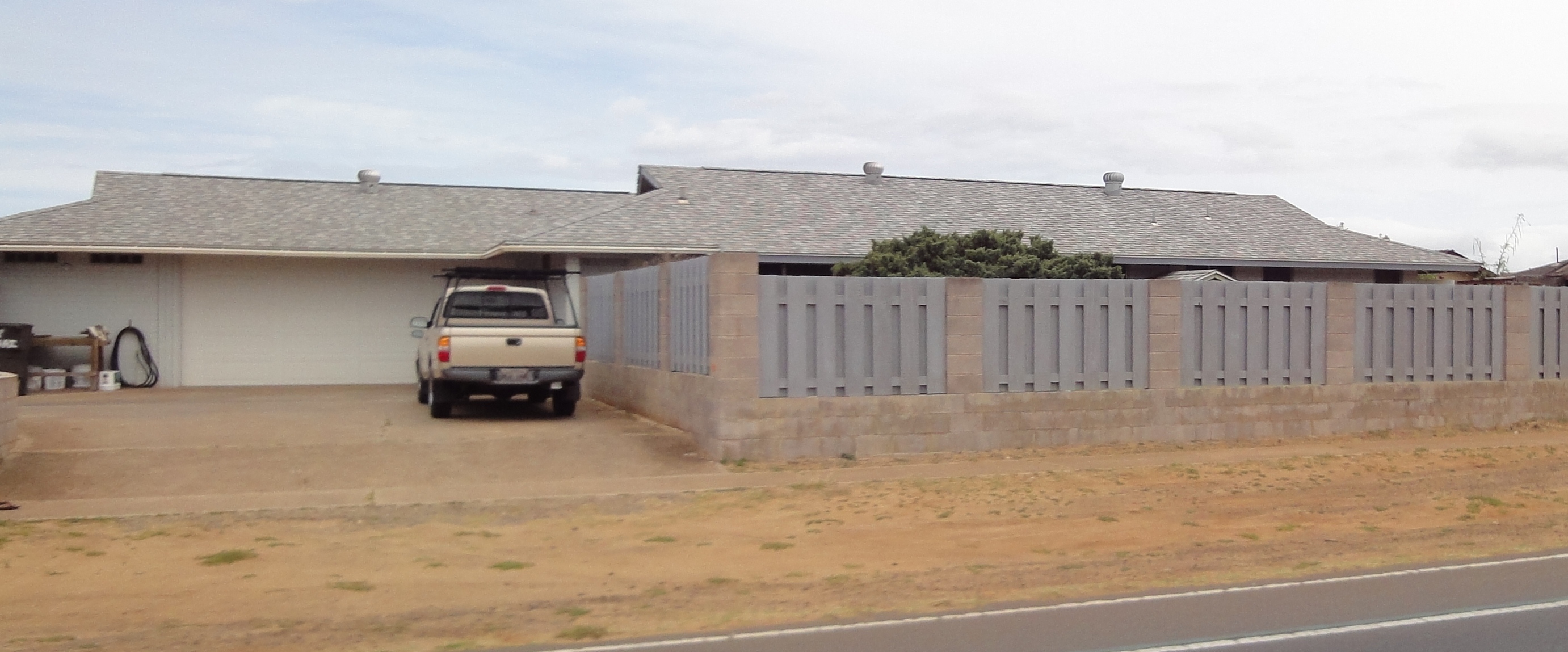
Chuck and Zannah’s place in Haiku. The ohana is in the foreground and the house in the back.

This trip has been different for me. Usually when I travel, I spend no more than 2 nights in the same place and those are usually in a hostel, B&B, hotel or camping. I’m always leery of staying with friends because I don’t want to be an imposition. This trip I have stayed the whole time with an old friend and her husband. I’ve stayed with them before, but never this long. In fact I’m not sure I’ve ever stayed with anyone this long!

They are well set up for long term visitors. Their ohana, guest house, is separated from the house and I can come and go easily without disturbing them and so can they. Their compound reflects who they are: Chuck’s fishing boat sits on a trailer by his shop where he does woodwork and custom welding; there are a myriad of gates, kennels, scratching posts, etc., for the 4 dogs and countless cats that come through Zannah’s informal rescue mission; the house is set up for friends with the kitchen integral to living/dining area and the ohana allows for friends from afar to come and stay.

Unlike most trips, I have not been obsessed with seeing this or going there, determined to optimize my time here by hurrying to the beach to relax. The first day I visited a couple of places, one I hadn’t visited before, but then I started staying here at the ohana more. It’s a beautiful place to be and I feel very relaxed here (and that IS why I took the trip!). I’ve read several books, napped in the afternoon and talked story with Zannah. There was a time in my life when I would have been beside myself with anxiety because I wasn’t doing anything (and, truth be told, that anxiety does creep in sometimes), but for the most part, just being here is fine.

So today maybe I’ll drive to Hana and Kaupo just to prove I can be while I do. Or maybe not.

Leave a comment

Filed under Hawai'i - 2012

Whales

March 4, 2012 7:30 AM HST

What is about whales? Is it just their size? Their grace?

Yesterday we went out on Ma’alaea Bay in my host, Chuck’s, fishing boat. He’s a commercial fisherman and his eyes picked out every blow. Seen from afar, they are tantalizing little spots on the water, but up close, one cannot help but feel a profound sense of awe.

A mother and calf appeared 100 yards from the boat and we watched them roll through the gentle waves, blowing and occasionally showing their flukes as they dove. We were hoping to see one of them breach, but that wasn’t to be. Just seeing these majestic creatures, much bigger than the boat, was enough. Later we saw a pair of adults. They moved almost in unison, undulating slowly through the sea. In the far distance an adult breached twice.

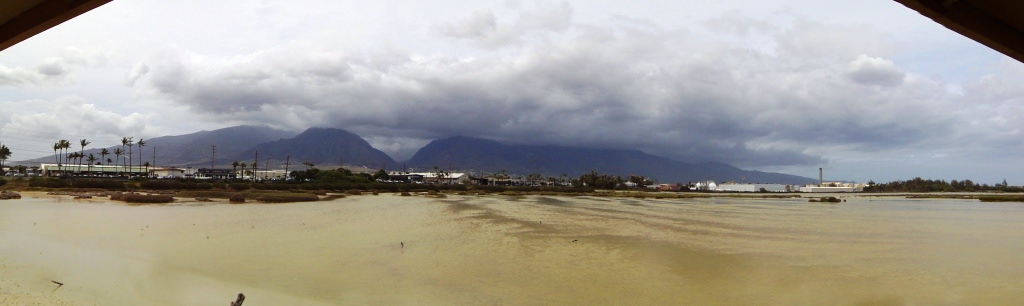
As a tourist, I often find myself looking for the spectacular, the incident to talk about, “Yeah, I saw a huge Humpback breach right in front of the boat!” But the true joy in this outing for me was just drifting in the gentle swells, looking back at the two volcanic cones that form the island of Mau’i, feeling very small in the vastness of whales and the sea.

Leave a comment

Filed under Hawai'i - 2012

Changes in Latitude

March 3, 2012 5:30 PM HST

One of the things I found when I first went to the southern hemisphere is that things I didn’t think I noticed actually had been imprinted. If you had asked me if I knew the stars in the northern sky I would have said I knew a few constellations if I looked for them, but otherwise, no. The first night I had a chance to be under the stars, I immediately found that I was looking into the sky for something familiar. There was no Big Dipper, no Polaris, but a new signature constellation, the Southern Cross. I took a while to get used to it, but then I started to notice some familiar constellations faint in the northern sky.

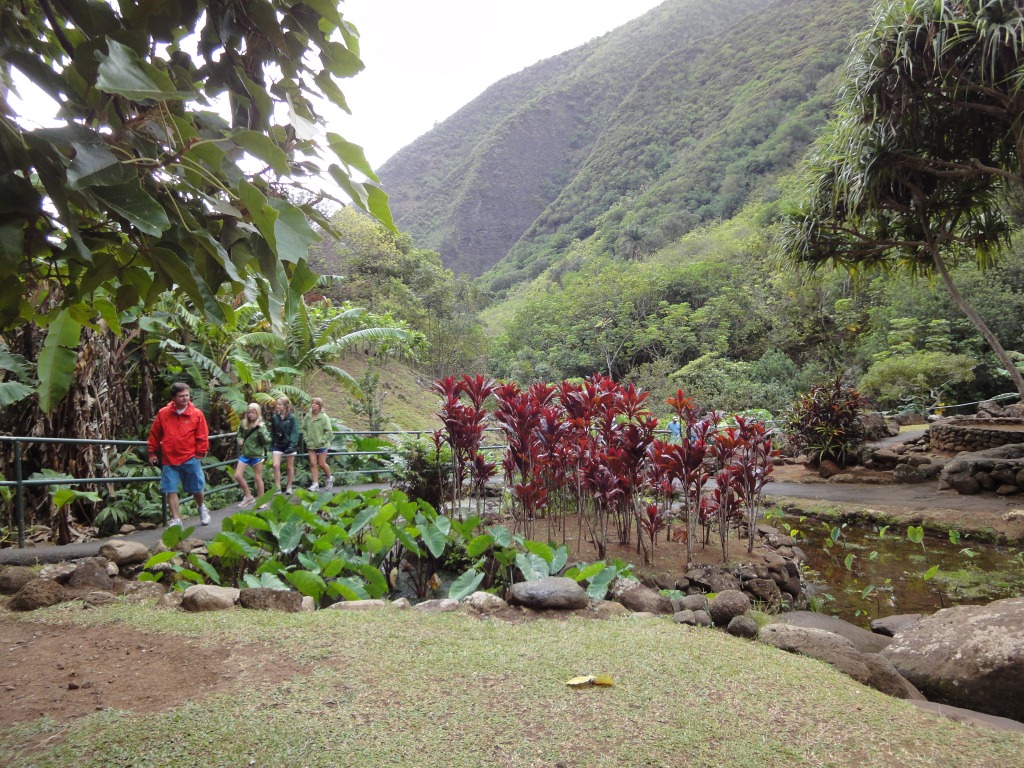
When I got here, the doves in the morning were familiar. As I hiked up the Waihee Ridge Trail, a whole new set of bird songs were audible. As the trail climbed out of the meadows and into the woods, those songs changed. As I climbed further out the woods and into the clouds, the songs disappeared altogether.

Henry Lickers, a Mohawk scientist at Akwesasne (and the head of the Environment Division of the Mohawk Council of Akwesasne) has developed a theory of natural knowledge. Essentially the idea is that we learn things about our natural environment that help us survive. Those things aren’t necessarily learned consciously, but sometimes they go directly from our senses to our judgment centers without passing through language that converts them into the symbols that our rational mind processes.

When I visit a place, I start that process of accumulating natural knowledge. It doesn’t progress very far—I don’t have survival needs that depend on it—but some of it stays with me. Some of the bird songs in Hawai’i stick with me. I have learned that the rocks aren’t as sticky and I have to be more careful walking on them (although it sometimes takes a fall on my keister to remind me). There are a myriad of things I know rationally about the area—Centipedes give a painful bite, lava comes in different types—but it’s all very cerebral. I am a babe in these woods.

Leave a comment

Filed under Hawai'i - 2012

Hidden in Plain View

Olowalu, March 1, 2012 3:00 PM HST

One of the things about Hawai’i that always catches me off guard is the fine grain of diversity here. You can be driving through a cloud forest and 3 minutes later you are in a brown desert. Or a red desert or a golf course farm. The same is true of the culture. One minute you are in a community of condos, the next in run down shacks. Not that the folks in the run down shacks are any less happy or interesting than golfers in plaid pants, mind you.

The stretch of road between the Ma’alaea Harbor and Lahaina captures a lot of this. There are tended beach parks along the way and there are stretches of beach in between that are untended and trees grow over some of the beach. The latter are often occupied by people who are squatting there for the long term. Periodically the authorities come around and kick them all out, but they return. Both types of beaches are used by tourists and natives alike and while the difference is generally pretty apparent, they coexist amiably for the most part.

There is a dot of a town on this road, Olowalu (“many hills”), that captures this fine grain diversity. There is the Olowalu General Store and the Olowalu Juice Stand. And that’s it for business. Taking a turn toward the ocean in Olowalu leads you within yards to a gated private home, but a dirt track to the left leads around the private property to the sea. There is a parking lot and a short walk to the edge. Turning right leads to a mown lawn, part of which is private and part public, and a jetty.

Olowalu Beach

Some other interesting features of the place were the skeleton of a building of some kind, possibly an ammunition bunker, and the huge stump of a tree that must have been cut down 50 years ago.

Leave a comment

Filed under Hawai'i - 2012